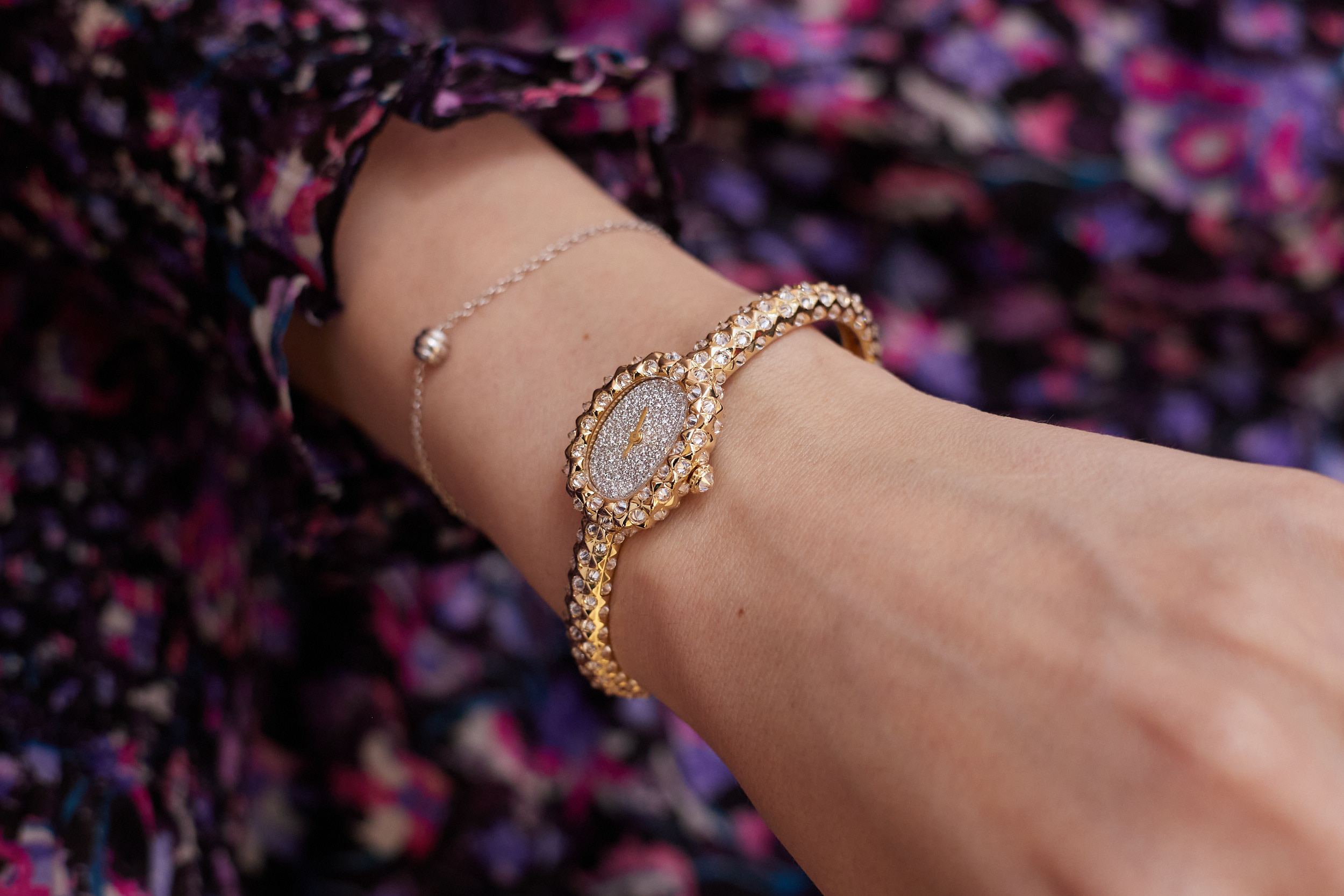

At the Watches and Wonders 2026, Cartier unveiled three new pieces in the tenth edition of the Cartier Privé “Les Opus” collection. The Santos-Dumont received an obsidian dial update, while the Roadster finally returned after a 24-year hiatus with refined movements.
An Automotive Icon Returns
Let us start with the revival of the eye-catching, automotive-inspired Cartier timepiece, the Roadster. It initially debuted in 2002 and borrowed bold codes from mechanical bodywork, featuring a speedometer-inspired dial, conical crown, headlight-shaped date magnifier, and visible rivets. The tonneau-shaped collection, which included time and date pieces in various sizes for men and women, as well as chronographs with horizontally elongated oval sub-dials, was in production for a decade.
Cartier returns to the Roadster in 2026. The new model maintains the codes of the predecessor while refining sophistication and aerodynamic allure.
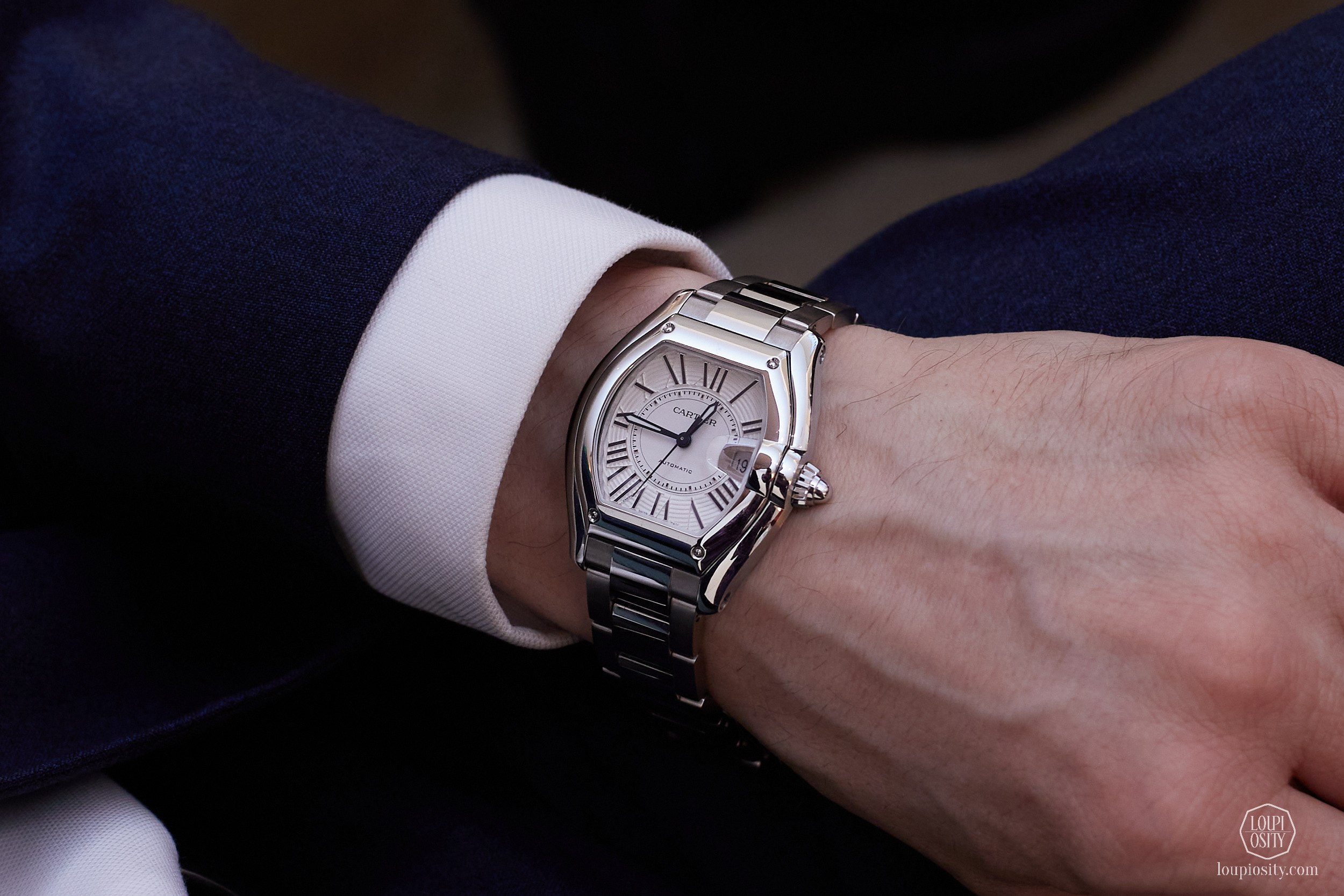
The dial preserves the circular striated pattern, rail track, and Roman numerals, enhanced by an ‘appliqué’ effect created through stamping and varnishing techniques that add relief to the indices. The Manufacture introduced three material versions: one in yellow gold, one in steel, and a gold-steel combination, offered in Medium and Large sizes.
The earlier models had ETA movements. As ETA has only supplied movements to Swatch Group brands since 2020, Cartier created its in-house calibres to replace the earlier ETA movements. The 2026 novelties are equipped with the 1847 MC (MC = Manufacture Calibre) for large models (47 x 38 mm, 10.06 mm thick) and the 1899 MC for medium models (42.5 x 34.9 mm, 9.7 mm thick). The bracelet has been reworked with shorter, more ergonomic links and the patented QuickSwitch™ system for strap interchangeability. Steel versions feature blue or anthracite sword-shaped hands coated with Super-LumiNova®.



Santos-Dumont novelties
The Santos-Dumont remains one of watchmaking’s most significant milestones. It was the first modern wristwatch designed for flight, created in 1904 for aviator Alberto Santos-Dumont. For 2026, Cartier introduces an LM-size version featuring a dial crafted from gilded obsidian, a volcanic stone from Mexico whose iridescent reflections come from tiny trapped air bubbles. Each piece is unique, with the stone cut to just 0.3 mm depth before being polished to reveal its radiance.
The bracelet represents the technical highlight of this release. Inspired by the flexible made-to-measure metal bracelets developed by the Maison in the 1920s, the yellow gold version comprises 394 links across 15 rows, with each link machined, finished, and assembled at the Manufacture. The 1.15 mm thick links create a fluid, silky and smooth feel against the skin.
Two additional LM-size models join the collection in yellow gold and platinum, both featuring silvered satin-finish dials with sunray effect. All three share the 3Hz 430 MC hand-wound mechanical manufacture movement offering 36 hours running time when fully wound. The case measures 43.5 x 31.4 mm with a thickness of 7.3 mm.



The Tenth Opus of the Cartier Privé
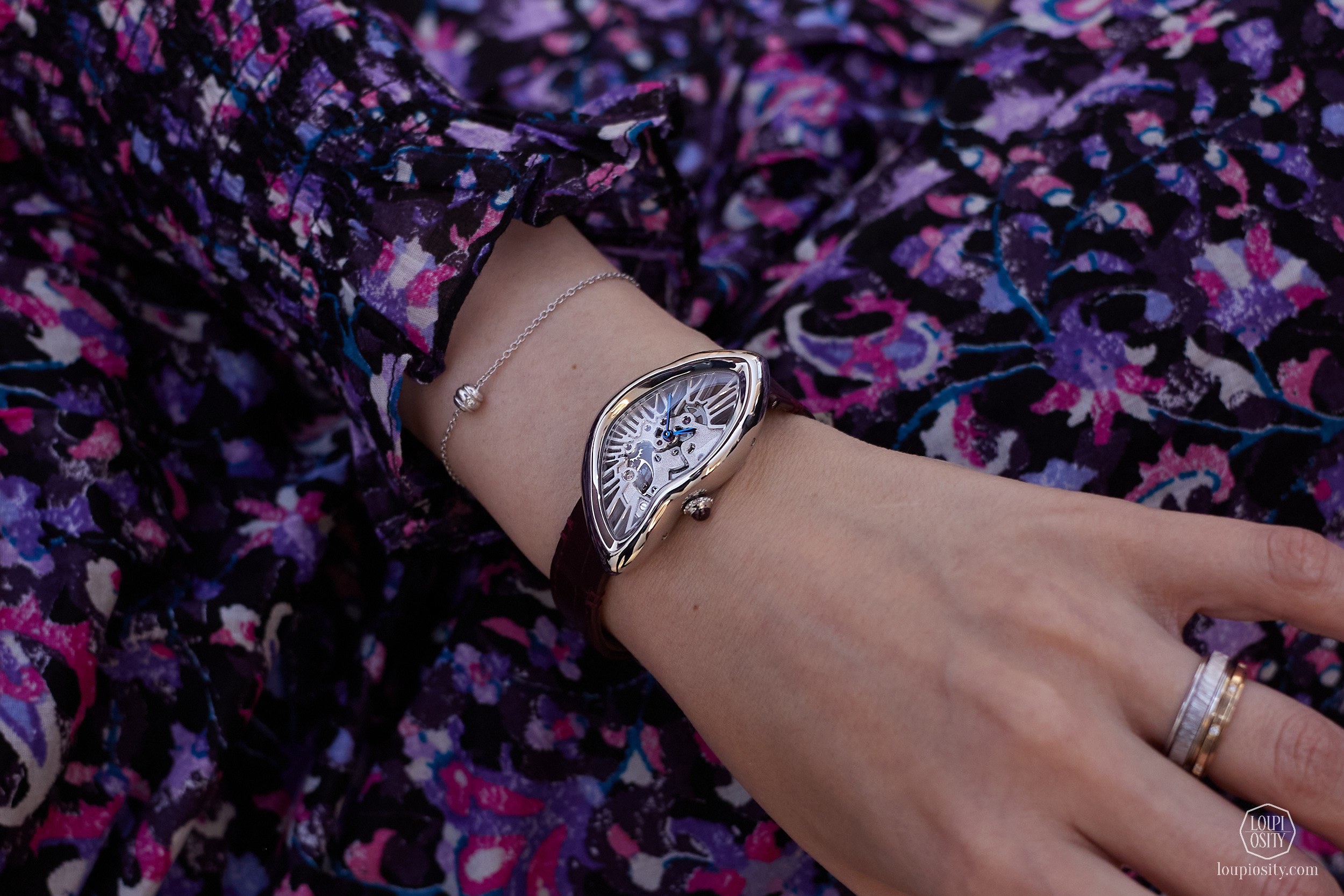
For its 10th Opus, Cartier Privé celebrates three emblematic shapes from previous editions: the Tank Normale, the Tortue Chronographe Monopoussoir, and the Crash Squelette. This exceptional triptych pays tribute to platinum, the Maison’s signature material, unified by a chromatic combination of platinum and burgundy.
The Tortue Chronographe Monopoussoir reinterprets a 1998 Collection Privée model, housing the Manufacture 1928 MC movement, the Maison’s thinnest chronograph at 4.30 mm. The start, stop, and reset functions condense into a single push-button integrated into the crown. The Côtes de Genève decor emphasizes the bridge curves, visible through the sapphire caseback.

The Tank Normale echoes a 1934 model with its seven-row platinum bracelet. The brushed finish on the case and bracelet contrasts with polished edges on the case rim. Silvered opaline dial with burgundy Roman numeral hour markers completes the ensemble.
The Crash Squelette represents the collection’s centerpiece. Created in 1967 during Swinging London, the Crash revolutionized watchmaking aesthetics with its asymmetrical dial (find beautiful early pieces in our coverage from the Cartier ‘Rare Watches’ exhibition in Geneva and the Phillips Geneva Watch Auction: XX). The 2026 version features a skeletonized Manufacture 1967 MC movement where bridges are shaped like Roman numerals. Each bridge is hammered by hand for nearly two hours using traditional decorating techniques. Limited to 150 numbered pieces, this model exemplifies the quest for harmonization between creative freedom and technical exploration.


Illustrating the Maison’s mastery of form and material, Cartier presented exciting jewellery watches in the Baignoire and Myst de Cartier line. Find our coverage here.
Photo credits: Cartier, Loupiosity.com
All registered trademarks are property of their respective owners.
All rights reserved.