
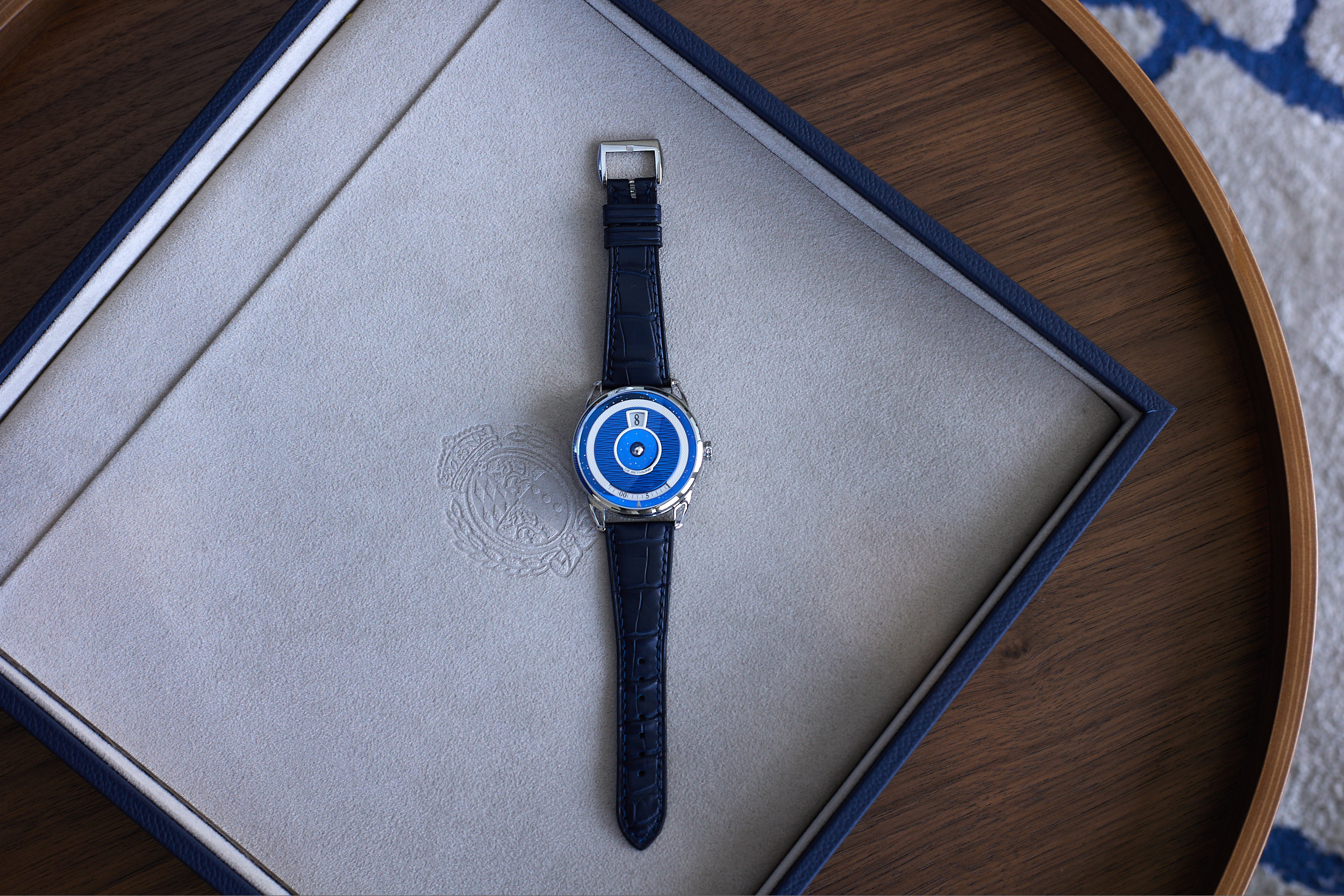
De Bethune presented the DB25 Digitale at Geneva Watch Days 2026. The revival of the digital-display concept, flanked by two earlier 2026 pieces, waited for me at De Bethune’s quiet showroom six floors above the Rue du Rhône today.
The move from the Beau Rivage hotel, used in prior years, to their own saloon was a deliberate one. The quietness of the showroom compared to the busy hotel currently undergoing renovations is better suited to handling watches and receiving guests.
Three pieces were waiting for me when I arrived. The novelty of the show, the DB25 Digitale, sat in the center, while the DB25Vxs Silver Moon and the DB28xs Dark Sand, earlier models from this spring, occupied the flanks. Together the three traced a chromatic path from blued titanium through silver to anthracite zirconium.
The DB25 Digitale
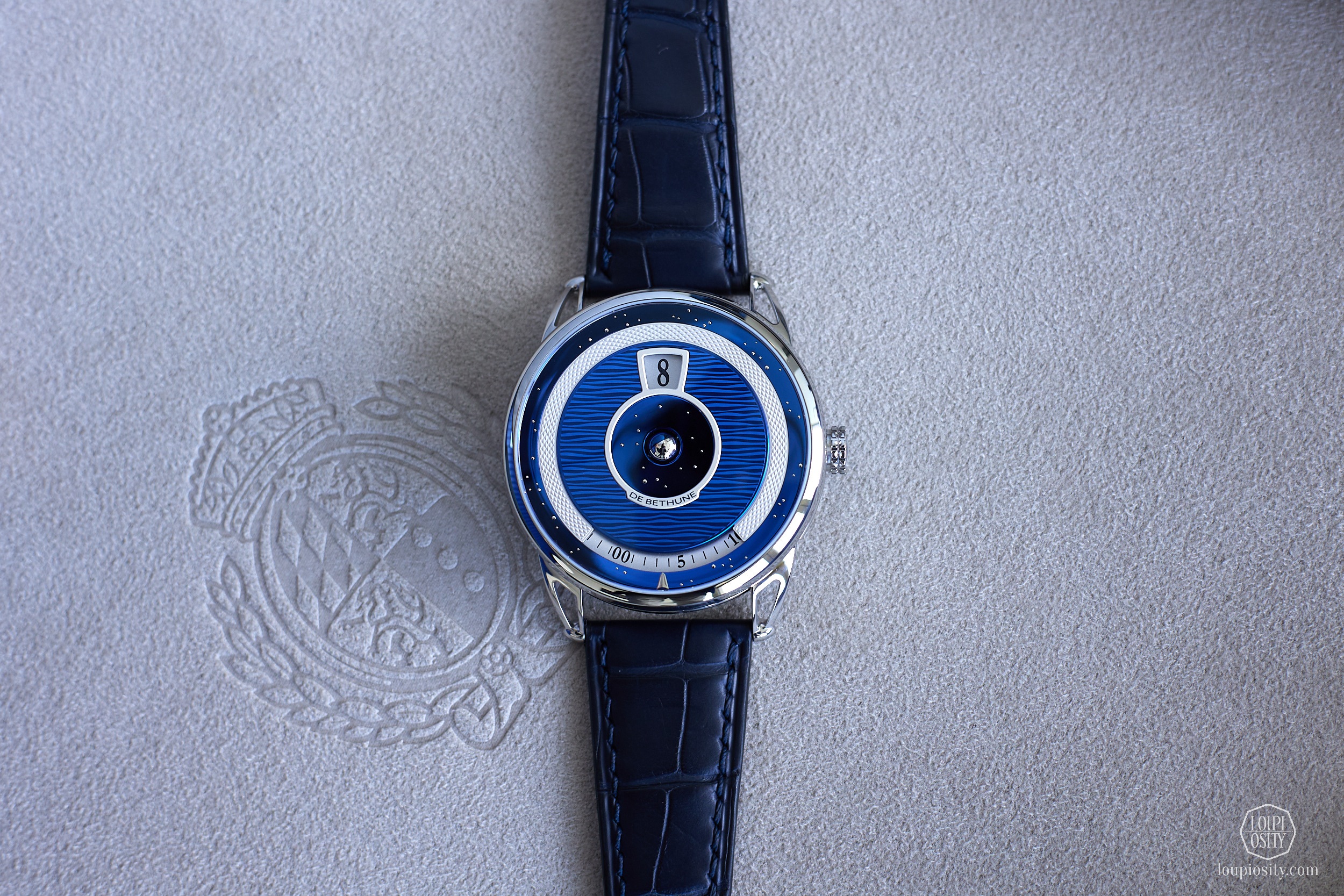
The DB25 Digitale is a return to a concept De Bethune first explored over two decades ago, the digital display of time. The display combines jumping hours in an aperture at 12 o’clock, analogue minutes on a rotating disc at 6 o’clock, and a central spherical moon-phase indication inclined at 60 degrees. No hands, no hour markers. Time is read through apertures and rotating elements, leaving the dial as a composed surface.
Blued titanium carries De Bethune’s random guilloché introduced in 2023, alongside a beautiful hand-guilloché barleycorn motif on the silvered minute sector. The fixed chapter ring and spherical moon surround are polished, blued Grade 5 titanium set with grey-gold stars. For the first time, the random guilloché extends onto the deltoid bridge visible through the sapphire caseback, bridging dial and movement in a way De Bethune had not previously attempted.
The case is 42 mm Grade 5 titanium, mirror-polished, with integrated openworked lugs of the maison’s bullet aesthetic and an extra-supple dark blue alligator strap. Beneath the dial sits the calibre DB2144V3, the third generation of a movement family that traces back to the original DB2144 of the mid-2000s. The calibre retains the self-regulating twin barrel introduced in 2004, the titanium balance wheel with grey-gold inserts patented the same year and optimised in 2016, the De Bethune balance spring with flat terminal curve, the silicon escape wheel, and the triple pare-chute shock-absorbing system. This is a visual evolution, with no major structural changes.
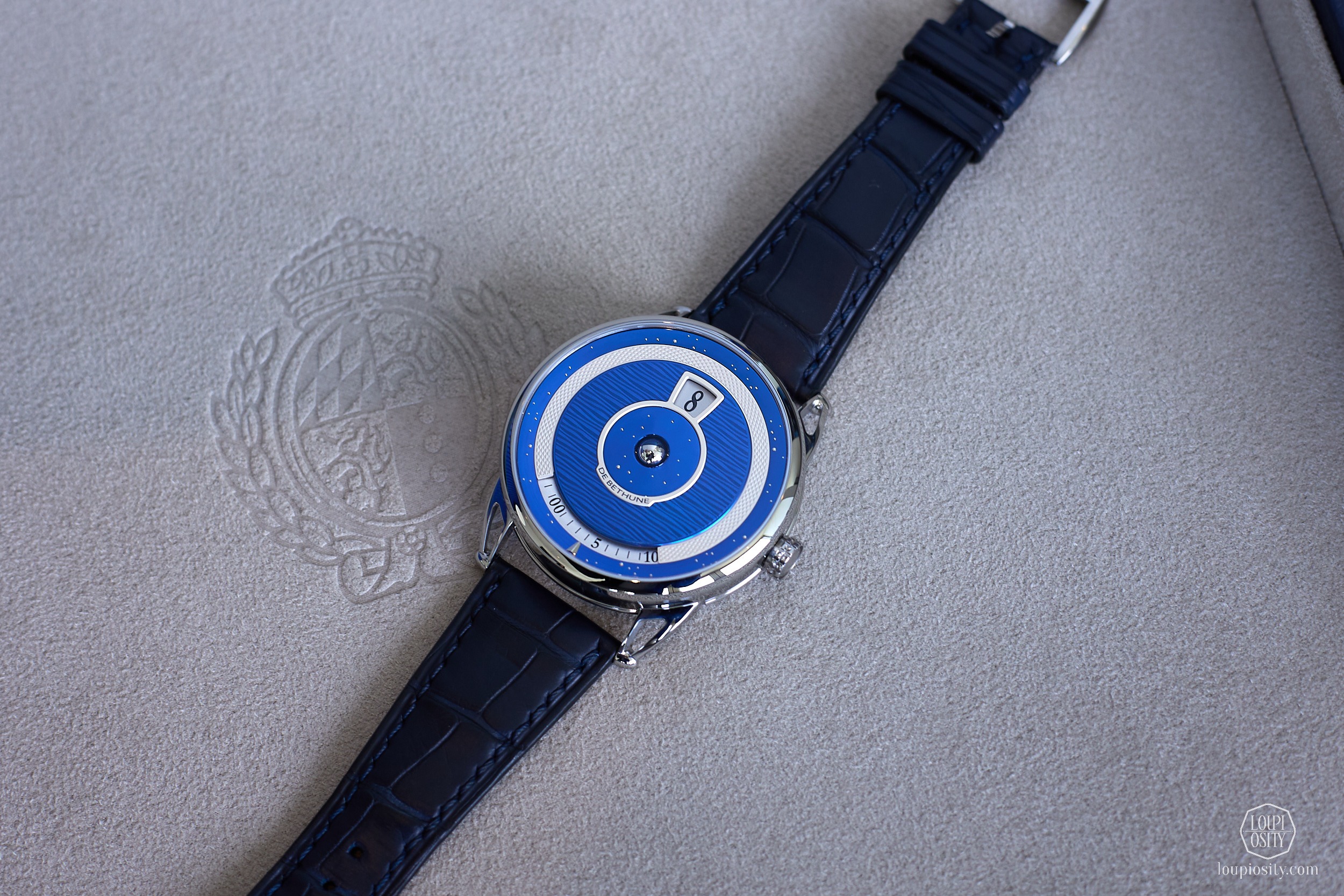
“To break free from the traditional codes of telling the time is to open up a space for creation: working deep into the material, exploring finishes, playing with light, until an almost painting-like harmony emerges. Time is no longer something you register — it becomes something you contemplate.” – frames the new release Denis Flageollet, co-founder of De Bethune and master watchmaker.
De Bethune’s signature spherical moon phase, patented in 2004 and first seen in the DB15, occupies the center of the Digitale. The mechanism draws on the long tradition of astronomical clocks and on Leonardo da Vinci, whose sketch in the Codex de Madrid De Bethune cites as a reference point. The moon itself is a sphere of palladium and flame-blued steel, emerging from a blued titanium sky set with gold stars. In the Digitale, this indication is accurate to within one lunar day every 1,112 years.
The digital-display lineage reaches back to the original DBD of around 2004, a horseshoe-cased piece with a crown at 12 o’clock that combined a digital hour display with a triple calendar. In 2014 the DB28 Digitale appeared with a 45 mm case and spring lugs, and the mentioned calibre DB2144 within. Almost a decade later, the DBD Season 2 came out in a 13-piece limited burgundy and zirconium edition as the product of a collaboration with Swizz Beatz. The DB25 Digitale presented today is the next evolution of the concept.


The DB25Vxs Silver Moon
The elegant DB25Vxs Silver Moon was introduced in April 2026. The three-dimensional moon phase indicator sits at 12 o’clock this time. The dial is silver-toned, hand-guilloched with a barleycorn motif arranged in circonvolutions. Curved rose gold hands pass over the spherical moon during their journey, watched by the white gold stars of the night sky from underneath. The case is 40.6 mm in polished Grade 5 titanium, with a discreet bezel and the maison’s fine, openworked lugs. The calibre DB2105V5, a hand-wound movement with 249 components, delivers a six-day power reserve through a self-regulating twin barrel.
The Silver Moon reinterprets the DB25L, a piece launched in 2009. De Bethune traces the design’s inspiration to the 18th-century haute horlogerie of Ferdinand Berthoud, Antide Janvier, and Julien Le Roy, with the dial’s slight curvature borrowed from floor regulators. “Chaque De Bethune est l’esquisse de la suivante.” Each De Bethune, in his words, is the sketch of the next, as Denis Flageollet described the maison’s creative evolution in the Silver Moon’s release.


The DB28xs Dark Sand
The DB28xs Dark Sand is the most visually radical of the three. An interpretation of the DB28xs Steel Wheels presented at Geneva Watch Days 2024, it adopts matte anthracite zirconium in place of polished, shifting the watch from a piece that reveals light to one that absorbs it.

The dial base is black sandblasted titanium, lending a mineral density. The hours and minutes track is circular satin-finished black titanium, punctuated by polished purple hour markers of the same metal and matching hands. At the center, the anthracite deltoid bridge with barleycorn guilloché appears almost suspended, its bevelled, sandblasted, and polished edges creating transitions from anthracite grey to deep black.
The characteristic floating lugs and the pin buckle are also made of zirconium. The hand-wound calibre DB2115V13 consists of 241 tiny components, beating at 28,800 vibrations per hour for six consecutive days.
The 38.7 mm diameter follows the XS collection’s downsize logic, introduced in August 2023 as a smaller interpretation of the DB28.


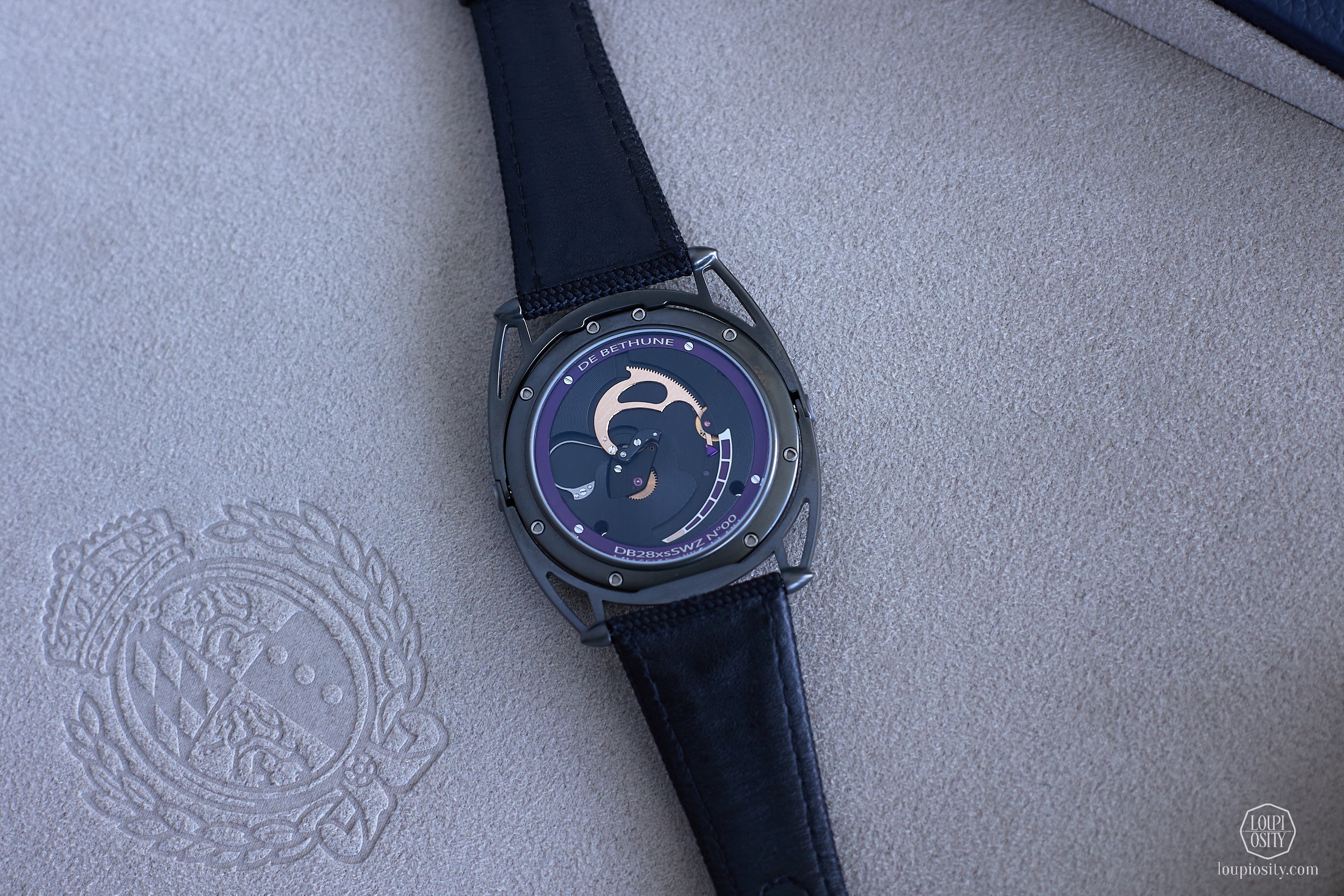
Photo credits: Loupiosity.com.
All registered trademarks are property of their respective owners.
All rights reserved.


